And, here's the speech I actually gave. I made the mistake of listening to the top seven speeches on American Rhetoric here, and I had to re-write it the night before to add a little more meat. I won another ribbon! (To be fair, I had no competitors.)
Project 6
Vocal Variety
“Stairs”
July 26, 2006
Intro:
Stairs have been on my mind lately. I’m drawing a seven story condominium with two levels of parking beneath. There are a lot of stairs.
I. But this is a luxury condominium with 4 elevators. The stairs are strictly utilitarian. They’re a product of the building codes. A building this tall needs at least two fire rated exits, and these are them. The dimensions in every direction are exact to the thousandth of an inch. They’re made to be functional. They’re so complicated to draw, with the handrails and guardrails at certain heights, criss-crossing the balusters as they go up and down, that there’s not enough time to make them beautiful or dramatic. And that’s not the point. They’re not meant to be seen. They’re not meant to be used. They’re only an escape.
II. Eight miles away, in a small church near the ground in downtown Raleigh, I meet with a pastor and a table full of leaders in his community. We’re also trying to design an escape. We look for an escape from poverty, from generations of need, from a lack of ambition, and a lack of ideas good enough to change people’s hearts.
III. Some might say that they need a stair. They need a fire escape up from the pit they’re in. And that’s not a bad metaphor.
IV. We can give them steps to take. We can show them the direction out. One step might be financial assistance for their needs at hand. One step might be jobs training and a connection to an employer. Another step might be after school programs to pick up where their integrated schools have still failed to inspire.
V. But how far will that get them? Three steps in the air? Four?
a. And why would they take that first step? Is there any incentive at the first landing?
b. And if they got to the second floor, where would they be? Who would they know? What reason would they have to stay?
VI. Stairs might be a strange metaphor, but it’s not a new one. You’ve heard Zeppelin’s “Stairway to Heaven” in all its contorted forms. But, do you remember the source? In Genesis, Jacob went to sleep in the Promised Land and he had a dream. He saw angels ascending and descending the stairs between earth and heaven. God has come down to man. Man doesn’t have to climb the stairs on his own.
VII. So, in some ways, poverty is a pit. It’s an impossible hole to scale. To get out takes a miracle. It takes an elevator! Or better, it takes a rocket ship to jump higher than anyone can climb.
VIII. However, we must not confuse the community of this tiny church on the ground with the poverty that surrounds it. Just as we must not confuse my luxury condo in the sky with any height of perfection or attainment. We must not confuse the altitude with the metaphor. Both spiritual poverty and wealth may be present at the same time, just as both poverty and spiritual wealth may be present at the same time.
IX. If we build new stairs for the poor, they should be stairs of family, rebuilding so many broken homes. Stairs of a just education, above the betrayal of the system. They should be stairs of new local business and enterprise to bring funds into the community instead of frittering funds constantly outside the community.
X. When I visit my friends in the small church on the ground, the only stairs I use are the few steps going up to their church door. We sit around the same table in the same room. We're on the same level. We build the stairs together, but more importantly, we all watch for the stairs that have come down to us.
Thursday, July 27, 2006


Sunday, July 23, 2006
Stairs - Speach #6
I'm returning to my roots for speach number 6. Again, thankfully, I've got a couple days to clean this up:
Project 6
Vocal Variety
“Stairs”
July 26, 2006
Stairs have been on my mind a lot lately. Designing a seven-story condominium with two levels of parking beneath, there are lots of stairs. In architecture, stairs are arguably one of the most significant elements. They’re dramatic and elegant, they’re metaphorical, they’re necessary and very code sensitive.
I. My stairs right now:
a. The stairs I’m drawing now are only utilitarian – this building has four elevators, we don’t expect the tenants to take the stairs except in an emergency.
b. Stairs are the most code sensitive parts of a building
i. They’re required exits – you can’t rely on the elevators in an emergency.
ii. Walls around stairs have to hold up to fire for two hours.
iii. They have to be a minimum width – at least 44 inches.
iv. Treads have to be at least 11 inches, the risers can’t be more than 7”, and they have to be consistent. The nose of a tread has to be 1”.
v. The handrails have to be at 36” above the nose of the tread and have to extend 12” beyond the top step and one tread plus 12” beyond the bottom step. An open stair has to have guardrails at 42”
vi. Balusters can’t be more than 4” apart.
vii. Landings have to be at every 12’ of rise, and have to match the width of the stair.
c. Stairs are a pain to draw!
i. Have to draw at exactly the right dimensions so you know how many steps you need and make sure you meet code.
ii. Have to think in three dimensions –
1. Draw in plan and in section.
2. Is there enough room in the plan?
3. Is there enough headroom underneath?
4. Do all the stairs line up vertically?
iii. Despite our best Computer Aided Drafting software, we still have to draw stairs line by line – the handrails and the guardrails crossing each other, turning, going up the next flight beyond.
iv. If anything changes (and things always change), you have to start all over with new calculations!
II. But while I’m drawing these, I’m thinking about everything a stair could be:
a. Memories –
i. Sesame Street: Cookie Monster as Alistair Cookie for Monsterpiece Theater presents “Upstairs, Downstairs,” starring Grover.
ii. House growing up – Mom did laundry downstairs.
1. Scar on my forehead from falling down the stairs as a baby, wanting to show her something.
iii. Sitting on the South Carolina statehouse stairs after prom with my friends and a couple bottles of Sparkling Cider.
iv. Climbing the stairs up the Eiffel Tower in Paris, all the way up, not wanting to look down.
b. Stairs can be extremely grand and dramatic
i. Think of beautiful Victorian houses with a grand staircase in the foyer, with a woman in a beautiful dress descending.
ii. Remember the Fiddler on the Roof? “If I Were a Rich Man”:
1. There would be one long staircase just going up,
And one even longer coming down,
And one more leading nowhere, just for show.
iii. Think of all the steps on the national capital building.
iv. Or a stadium surrounded by stairs and seats
v. Or, in the “Lord of the Rings,” stairs cut into the rock on a treacherous mountain pass
c. Stairs can be inventive and creative.
i. Look at stairs in modern home magazines – metals, glass, cable rails
ii. Thomas Jefferson brought from European monasteries: alternating tread / monk’s stairs, to save floor space
d. Stairs can be a metaphor for something much bigger
i. Led Zeppelin’s “Stairway to Heaven”
1. Reference to Jacob’s dream in Genesis of a ladder or stair (depending on the translation) with angels ascending and descending between Heaven and Earth
ii. Madeline L’Engle (children’s author of “A Wrinkle in Time” and lecturer on art and faith) talks her memories of going down stairs without touching them, and wanting to reclaim that freedom of childhood.
1. I used to have dreams about flying down those stairs to our basement and flying around the family room. (What did that mean?)
iii. For someone disabled or in a wheelchair, stairs can be a barrier and a reminder of an insensitive world.
1. Americans with Disabilities Act of 1990, requiring access ramps at any change of level.
iv. Or for someone in a fire in a tall building, this is the only safe place and the only way out.
1. Brings us back to the code and my utilitarian stair sections.
So, remember me next time you climb the stairs to your office building or home. Remember what a stair can be. By now, my stairs had better be done. I have a presentation on Friday, even if the condominium tenants will probably almost always take the elevator.
Monday, July 10, 2006
World's Best Way to End a Chapter
These are the last few short paragraphs of chapter 3 of "If on a winter's night a traveler" by Italo Calvino:
In that moment of harmony and fullness, a creak made me look down. Huddled between the steps of the platform and the supporting poles of the shed was a bearded man, dressed in a rough, striped tunic, soaked with rain. He was looking at me with pale, steady eyes.
"I have escaped," he said. "Do not betray me. You must go and inform someone. Will you? This person is at the Hotel of the Sea Lily."
I sensed at once that in the perfect order of the universe a breach had opened, an irreparable rent.
Friday, July 07, 2006
Borrowing from a blog
A friend's blog posted what turned out to be a quite existential article on interstates. I was proud of him, so I posted this response: (reprinted here because I liked my response too and I'm not entirely sure that my post went through . . .)
In response to The Last Homely House: Interstate Memories
Thanks Pastor. Excellent essay. Thanks for sharing.
Where to start a reaction to this? (But, of course, to leave it alone would be inappropriate.)
Reading through the second time, seeing the photos now, the first thing I notice is Philip Johnson's PPG (Pittsburgh Plate Glass) building - a psuedo-gothic cathedral tower of glass, play-acting the part of something ancient with its spires in a modern setting for a modern corporation, with all glass, overlooking the river(s), overlooking the interstate.
Maybe what struck me first was how many memories you have of interstates and how you were able to form such significant opinions about them. It's this rush of emotions and opinions, spurred by a hundred voices of critics and cynics, all contradicting each other into the fact of your memories. For example - "So much spent on fossil fuels!" or "If only he had lived and worked in the city." Or the preservationist - "If it wasn't for interstates, we wouldn't have the problems with sprawl that we have today." Or the historical allegorist - "The interstates of today are what the railroads were to the settlers of yesteryear." Or the phlebotimist - "They're the veins and arteries of our standard of living." Or the college grad "I want to see the country before I have to get a real job." Or the salesman - "My territory stretches from Virginia to Georgia and most of Tennessee." Or the realist - "How much time WASTED inside an automobile." Or the automotive manufacturer - "God bless America!" Or Kevin Costner - "This here is a time machine: in the rear is the past, in the front window, why, that's the future."
You mention the mostly ugly landscape, in contrast to the "commercially devloped." But isn't this what the interstates really show us? Isn't this what the first locomotive passengers saw or the first astronauts who orbitted the earth? In all our moments of land planning and consumption and enterprise, we're just developing dots of land on an unimaginably long line. This is as much as we can do, and we all know that the developers are trying as hard as they can. (I pull the conversation this direction in lieu of the obvious reaction that many may consider flat pastoral land more lovely than the Wilco's and cigarette emporiums that also flower interstate exits.)
But you tried. You gave a flat run of land 3 years of your life and made no connection. Thoreau ached to have come to that kind of a disagreement with the landscape.
I confess I am a little sad that you had to drive so much to get where you are today. I also confess that I can't entirely relate. I've also been across the country, more than once, in an automobile, but I wasn't driving most of the way. And, I wasn't doing it for work. And I think commuting is a violent thing, in LA. But I also know that not much time in life feels more "real" than the time in a car, on an interstate. It's freedom at its most contemporarily literal. It's you and your thoughts and your prayers and your reaction time, committed to a machine for your destination and your best guess at a plan for the moment. Sometimes it's shared with company, and what an intimate relationship that is - one that's not easily forgotten. Oh, I'm slipping into my own memories, and this is your blog, so I'd better quit before I get to the story of the Indians I met on the ride-share board, "Turn on the indicator . . ."
Tuesday, July 04, 2006
Diversity, Freedom, and Evergreen Avenue
Another fortnight is upon us. Here's speech #5. Why do I pick such complicated subjects?! If you're in the neighborhood, feel free to stop by around lunch time. My wife says this is running long - still have a half hour before bedtime to trim it down.
Project #5 Your Body Speaks
Diversity, Freedom, and Evergreen Avenue
July 5, 2006
I. Intro
a. I’ve been thinking about freedom lately. We all have; it’s July 5th. Holidays remind us of the important things we might otherwise forget. I like Christmas because it makes me remember my family that lives far away when I have to go buy their presents. The 4th reminds us of our freedom.
b. But I’ve also been thinking about freedom because I’m president of our neighborhood association. When I try to remember why we decided to live on our street and why we like it, it’s not always an easy question. Our street reminds me of freedom, and I want to help keep it that way.
II. The declaration of independence
a. All men are created equal – what’s implied here is that not all men are the same – definitely true on our street
i. Look at the people
1. White, black, Latino, Russian with her head covered
2. Ages – kids, young families, grown families, elderly
3. Listen to the languages and music – late night battle of the subwoofers
ii. Look at the houses – I read a lot into what houses say about people
1. Top of the street - Browns – perfect lawn
2. Mexican house with mysterious shrine in their garage.
3. Fence house with bushes – extreme privacy
4. Safewrights – cinderblock house, hasn’t even changed paint color in 50 years
5. Pittmans – cinderblock house – all kinds of additions
6. New, eccentric houses – ours and the doctor’s
7. Small houses far away from the street, natural wild lawns
8. Developer houses – small, maintenance free, affordable
b. Mankind are more disposed to suffer, while evils are sufferable
i. Theme of live and let live
c. Form a new government – not for light and transient causes – we had some causes
i. Started this neighborhood association
ii. Causes
1. Crime
2. Danger
a. Worry about violence, a safe place for kids
b. Break-ins
c. Traffic – a perfect quarter mile drag strip
3. Property values
a. Bad development – old houses brought in, broken back rooflines, landlords who don’t care, tenants who don’t care.
d. Provide new Guards for their future security
i. The neighborhood association
1. Reminds all of us that all of us do care about our neighborhood
2. Neighborhood watch, communicating with police to combat crime
3. Communicating with developers, meeting them in city counsel when they try to bend the rules
ii. Considering covenants for better property value
1. Some way of tying our property to a commitment to see our community improve
2. A challenge in such a diverse neighborhood
III. So, the colonists declared independence against their tyrants.
a. They knew the risks
b. The imagined the benefits – could they have guessed their declaration would go so far?
c. Living on our street, I have a good idea of why they did it. It might have been easier to move to Cary, drive a minivan, and own a home only distinguishable by its number. But I’m thankful to be able to celebrate our inalienable rights of life, liberty and the pursuit of happiness.
Monday, June 19, 2006
Helping the Poor Should be an Ordinary Thing
It's time for another Toastmaster's speach. Here's a draft of #4. I've still got a day to clean it up:
Project #4 How to Say It
Helping the Poor Should be an Ordinary Thing
June 21, 2006
I. Helping the poor should be an ordinary thing.
a. It shouldn’t be a political soapbox.
b. It shouldn’t be the job of the few, the brave.
c. It shouldn’t be the subject of a startling speech.
II. “In the depths of darkest Raleigh . . .”
a. Wrong. The poor in Raleigh are our neighbors
i. The difference between a poor neighborhood and a trendy neighborhood can be just around a corner or opposite ends of a street.
1. Example – West South Street to Boylan Avenue
2. Example – North Bloodworth Street to South Bloodworth Street
3. Example – Oakwood Neighborhood to Boyer Street
ii. Especially in Raleigh, the lines between the Rich and Poor neighborhoods are blurred – we drive through these communities every day.
III. “They’re people with needs we can’t understand.”
a. Wrong. Their needs are the same as ours.
i. Progress Energy electric bills, efficient housing, safe neighborhoods, transportation to jobs, local education
b. They have the same beliefs – we never debate theology;
c. The same priorities – caring for their children.
d. Difference in the number of economic choices.
IV. “Only a few brave souls can reach them.”
a. Wrong. Anyone can help another person.
b. It takes listening
i. What are the real needs?
ii. What need can you help now?
iii. How can you address the causes?
c. It takes matching resources
i. What can you give to match what they need?
1. Can you give Money? Leadership? Expertise?
V. “So, you’re saying poverty is easy to solve?”
a. No. It’s generations deep, but we can still help each other.
b. Don’t forget the big issues –
i. Education reform – equal education without busing,
ii. Property incentives – for wealth building
iii. Good policing and speedy justice – for safe communities
VI. Stop thinking it’s Us and Them. It’s all Us
a. Start by lending tools to your neighbor
b. Join an organization that helps people who you wouldn’t get to meet.
c. Then, when you get a chance, try out the soap box or the startling speech.
Tuesday, June 06, 2006
Good Art Isn't Safe - Take 2
My Toastmasters mentor said my speech didn't quite make sense yet. Here's the final draft:
Project #2 Get to the Point
Good Art Isn’t Safe
I. Introduction
a. Good art isn’t safe. Good art changes things. Good art can leave a lasting impact.
b. You’ve seen safe art – décor in hotel rooms, music in elevators. It matches the furniture. It doesn’t make you uncomfortable. It doesn’t need a second glance.
c. My goal is to highlight several forms of good art and describe its effects.
II. Literature
a. First time I was affected by good art was Senior year of High School - “The Stranger” by Albert Camus
b. A book about a character dealing with his place in the world
c. I was a lonely kid who thought the world was irrelevant – discovered I’m not alone being lonely and that I am a part of the world. This introduced me to existentialism – have been wondering if I’m an existentialist ever since!
III. Sculpture
a. One of the most famous sculptural icons is Auguste Rodin’s “thinker.”
b. You’ve seen him in commercials, cartoons, imitated by friends. Saw a store that had a foam “Thinker” on a stick, very safe.
c. Saw the work at the NC Museum of Art in context. The thinker is part of a much larger piece, a huge black door call the “Gates of Hell”
d. The character is thinking about his eternity – certainly not a safe question!
IV. Painting
a. Abstract painting can be safe if you don’t understand it – Picasso – “interesting”
b. Saw “Guernica” in Spain, about the Spanish Civil War
c. Unlike what you see in books, this was 25’ x 11’, fills the room, black, sprawling forms, a lightbulb, a flower on the ground, a broken sword
d. I’m a Republican, generally in support of just war, but the piece made me realize the atrocity of war in a more personal way than ever before.
V. Architecture
a. We are surrounded by architecture – we live in it, work in it, drive by it. Form follows function. It has to be safe, by code.
b. First year in college – Glass House by Philip Johnson
c. A shoebox of glass and steel
d. The definition of perfect proportions. Perfect placement of minimal elements – furniture, kitchen counter
e. Coincidence of indoor and outdoor – experience of nature blending with experience of being indoors
f. I found out what architecture could be and have fought with that in my profession.
VI. Music
a. Music is very familiar – especially for me – I grew up around it, I like it.
b. We had free tickets to the symphony recently on a Friday night
i. We were tired from work, had a hard week, considered staying home
ii. Classical music can be boring, especially when it’s unfamiliar
c. The piece was “Resurrection” by Gustav Mahler
i. The opening chords filled the hall, broke through my shell
ii. Wide range of emotions and experiences through the piece
iii. Still wondering about the meaning of the piece and how it could have been so powerful.
VII. Conclusion
a. Good art isn’t safe. It can affect you for years to come. It can affect whole cultures, across generations. Think twice before you visit a museum or put in that CD. You might get changed.
Tuesday, May 23, 2006
Experiencing Commuting
Now a competing member of Toastmasters, following is an outline for tomorrow's speech:
Project #2 Organize your speech
Experiencing Commuting
May 24, 2006
I. Introduction
a. In my four mile commute from home to work, I’m astounded by the contrast and variety of life in Raleigh. Because of the stoplights and turns, I rarely get above third gear, and this gives me the opportunity to interact with the experience between points A and B.
b. To tie into today’s topic, I’ll highlight some of the restaurants to help illustrate the contrast.
II. The first quarter mile is Evergreen Avenue.
a. Evergreen is a world in itself – a profound mix of races, collars, ages, and backgrounds.
b. The houses range from the 1958 cinderblock 1-story with its original owners to the up and coming 3000sf traditional with its wraparound porch.
c. This street is enough for a speech of its own.
III. Lake Wheeler Road
a. Contrast of people who are all stuck in a way, but trying to get out
i. Cross over I-40 – professionals stuck in traffic, trying to get to work
ii. Students heading up Centennial Drive to NC State, stuck in school, trying to graduate. Do you remember that feeling?
iii. Transients cross the road to get to the Healing Place – stuck in a difficult life, but working for a better life
iv. Dorothea Dix – a beautiful piece of land stuck with an uncertain future, trying to stay beautiful
b. Food includes the booming Farmers Market and a Subway at the Exxon.
IV. Left on Saunders, left on South Street, Right onto Boylan Avenue
a. Watch the contrast with me as we turn this corner.
b. South Street
i. South Street is fronted by run-down businesses and storefront churches.
ii. People wander on the street corners or wait for work. Everyone on the street is appears to be Black or Latino.
iii. The city of Raleigh has recently designated portions of this area “blighted” which means that they are too dilapidated for repair.
iv. There’s a food shop here, the Smoked Turkey Grill, a three run-down convenience stores.
c. Boylan Avenue
i. The Wake County survey tells me that the property value quadruples.
ii. This is where the Mayor lives.
iii. These houses are profitable fixer-uppers.
iv. People on the street walk briskly to their cars or jog with their dogs. Everyone we see on the street is White.
V. As we cross the Boylan Street bridge, we look on an astounding view of the city. The contrast here is of the past and the future.
a. Into the past, we look across the sea of railroad tracks, the history of industry and intersection in this town.
i. The tracks come and go three different directions – North, South, West.
ii. We see the warehouses that form the edge of town, Dillon Supply.
b. And we see the future. The skyline already shows new condominiums and cranes for towers under construction. Plans on the books and in the papers show many more new structures to come.
c. We come to one of our favorite restaurants – Moonlight Pizza. Super-fresh ingredients, a braided crust, and Blue Moon on tap.
VI. Finally, we turn onto Dawson Street and Glenwood Avenue.
a. This is where much of the new redevelopment began, with Clearscape’s renovation of the Creamery Building in 1999 and Cline Davis’s construction of the seven-story 510 Glenwood later that year.
b. Within just a few years, developers have turned this street from a historical novelty to the busiest strip in town on a Saturday night.
c. Food includes two fine coffee shops, burger joints, more pizza, family restaurants, bars, a high-end steakhouse, Chinese, Japanese, Cincinnati chili, two wine bars, and one Turkish ice cream shop.
VII. Whether your commute is as short as mine, or if you spend most of your route above the speed limit, I hope you’ll consider the contrasts that you pass on your way.
a. Who are the people who live in these houses?
b. Who are the owners of these businesses and how did they get where they are?
c. Are the cars beside me different than mine or the same?
d. Why do I drive so far every day?
e. We live in exciting and deeply interesting city, even at the infinite points between A and B.
Monday, February 06, 2006
The Author Complex
A friend encouraged me this week to write a book on a Christian perspective on Architecture. (As if I've never thought of writing a book on a Christian perspective on Architecture.) We tried to think of other similar titles - the only one I could think of was Ruskin's "Seven Lamps." It's probably about time for another one. And really, that's not fair - there are other Christian-Architecture books, and I haven't read them. However, this makes the point: perhaps the first challenge will be to write a book that someone will want to read.
My friend said he would help. The first thing is an outline. Then, make the book tell a story. Write a little bit at a time. What if you could write a page a day? In a year, it'd be a healthy size text.
But - a page. Have you ever tried to write a page? 8 1/2 x 11, or does 6x9 count, with 1" margins?
So, an outline:
1. Christian theory in architecture - creation, fall, redemption, creativity, environment. Get through this part quick.
2. Places - places we've been, what we see, what we feel, what we believe, what difference does it make?
3. Perhaps a tangent about elevators and commuter airplanes - what actually happens when that door closes and opens again into a new situation?
4. Something abstract - cf Italo Calvino's "Invisible Cities."
. . . to be continued
Tuesday, January 24, 2006
Reading again at lunch.
Having finished the architecture exams, having finished Libeskind's book (3 1/2 stars), having no one scheduled to meet for lunch, I resumed a happy habit yesterday of reading at lunch. The weather's gloomy, and the park is far away, but I found a corner in the back of the office that was quiet. I picked up Dostoevsky's Brothers Karamazov, with its bookmark in the high 200's, and started diving in again.
And, with a book like this (not disimilar from Joyce's Ullysses in mass), "diving" is the right word. The "story" is so massive, so omnipresent, so existential and overtly narrative; the paragraphs are so enormous, that I find myself swimming in the words, foating in the middle of sentences, pondering the author's intent, wondering about the realities of life in america, comparing them to the proposed realities of life in russia, pondering faith and fiction. It's not as if my months away from the book leave me detached from the characters: in fact, I feel in many ways that I relate to them better, in a real-time sense, as if the characters have been living their lives as I have been living mine, and now we get back together for an hour at lunch.
To say I go back to work then, refreshed, may be an exageration. I did read about a duel yesterday, and that was exciting, until the dueler apologized and became a monk. I could do that - work feels more often like a duel.
Sunday, November 13, 2005
Upcoming Photo Show
I've been preparing prints for a small photo show in a local business office. Here's my write-up:
Raleigh in 6 Small Prints
Photography by Andy Osterlund
Downtown Raleigh continues to grow and change. If architecture can be read, Raleigh’s streetscapes are building a novel. Walking the sidewalks, a visitor finds chapters on warehouses and industry, moderately ornate turn-of-the-last-century storefronts, towers of a growing banking center, neighborhoods of eccentric affluence and communities of generations-old poverty. Dramatic chapters are being written now, and the suspense is building: a multi-modal transit hub, neighborhood redevelopment, a returning urban population.
These photos are portraits of our moment in architecture. Remember the colors, remember the shadows, the perpetual changing of places.
1. Fashion Center of New York, Inc. Wilmington Street
No.2 in a series of 4 storefronts. The second floor windows are blacked; daylight is visible at the first floor – the rear wall and roof are absent.
2. Reliable Loan Wilmington Street
Closed on Sundays, the best place in town to get a used diamond ring. Who can miss this color?
3. Smoked Turkey Grill South Street
A new business on a desperate block. Blocks around the corner from the Mayor’s house. Pegged a “gateway corridor;” pending wholesale community rehabilitation.
4. Dillon Supply Steel and Pipe Products Harrington Street
The solid brick warehouse edge of the downtown. Now being emptied to make way for a colossal transit hub. Three silver SUV's.
5. Audio Buys Glenwood Avenue, near Fairview
An experiment in the International Style, just like Mies. Set across a wasteland of an intersection, flanked by BP and trimmed with power lines.
6. Firestone at Dusk Dawson Street
The sun catches this tire shop and the city on the crest of a hill, on a one-way street out of town.
All 5x7 Cibachrome prints, non-digital; all available for purchase.
Thursday, November 10, 2005
Liking Libeskind More
I passed the half-way mark today in Libeskind's Breaking Ground - almost up to page 500 on my PDA. My opinions have shifted several times.
Before reading, my asumption was that this would be an eccentric explanation of life or archi-theory, detached in too many ways from actual living or construction. Instead, within the first few pages, Libeskind describes his family and his heritage, his warm partnership with his wife, and then the experiences of touching the foundations below what was the world trade center in NYC.
Second, because of the conversational style, I thought it would be too overtly ghost-written, and wouldn't likely describe anything architecturally significant. However, the next chapters describe profound experience and metaphor and architecture that goes beyond form-follows-function.
He describes a relationship between a building and the public that is rare and extraordinarily significant for a city. Stories are about the cultural need for certain projects, the public's aesthetic and functional desires, and then the very one-on-one bureaucracy that attempts to divert the people's attention.
The word "democracy" comes up often, related to architecture in the interest of the people.
Tuesday, October 25, 2005
Breaking Ground with Daniel
Spurred by a non-architect's comments, I bought and started reading Daniel Libeskind's Breaking Ground: Adventures in Life and Architecture last night. An entirely theoretical architect until the last few years, this name has always been an intriguing mystery to me, and I'm excited to read his book - it looks actually pretty light for such an enigmatic character: I hope it's authentic. Of course, Libeskind has been in the news as the named champion of the New York WTC design competitions.
If anyone is interested in reading this with me, I guarantee you'll have no trouble keeping up. Let me know.
If anyone is interested in reading this with me, I guarantee you'll have no trouble keeping up. Let me know.
Sunday, October 16, 2005
Is Art Un-Presbyterian?
I've begun a study of Presbyterian thoughts about art. This started when I bumped into the Westminster Larger Catechism's explanation of the Second Commandment:
". . . the making any representation of God, of all or of any of the three persons, either inwardly in our mind, or outwardly in any kind of image or likeness of any creature whatsoever."
Our associate pastor has gotten me going on this too with some articles about the absense of Puritan art and general discussions of art in the church.
Reading Calvin's commentary today on the second commandment was very helpful. A few points: 1) All representational art is not wrong. 2) Representations of God are wrong because they insult God - so there's the bite to chew on. 3) Calvin and Westminster might not be saying the same thing.
Anyway - here's a link to Calvin on Commandment #2: http://www.ccel.org/c/calvin/comment3/comm_vol04/htm/iii.htm
Some comments from our associate pastor:
http://twosons.blogspot.com/2005/02/packer-pictures-of-christ.html#comments
If Calvin is right, what should we do with the Sistine Chapel? I can do without El Greco, and I still haven't seen Mel Gibson's Passion, and Monte Python's "Brian" was already blaspheme, and those laquered Jesus pictures always weirded me out, but Giotto and the Pietà Rondanini will be harder to let go.
This discussion will be continued on Peace Arts - www.peacepca.org/arts
Wednesday, October 12, 2005
samples that sing
A quick qualifier in choosing materials -
I ordered some samples last week for a project: glass block and acrylic "glass" block. I tapped the glass one with my pen and it rang out this happy note - the tone changes depending where you hit it on the block. The acrylic block makes more of a "thud" tone. A famous quote says that, "architecture is frozen music." So . . . maybe I'll tell our client that we should use glass block instead of acrylic because in a hailstorm it would sing a nicer song. It might be easier to find another excuse.
I ordered some samples last week for a project: glass block and acrylic "glass" block. I tapped the glass one with my pen and it rang out this happy note - the tone changes depending where you hit it on the block. The acrylic block makes more of a "thud" tone. A famous quote says that, "architecture is frozen music." So . . . maybe I'll tell our client that we should use glass block instead of acrylic because in a hailstorm it would sing a nicer song. It might be easier to find another excuse.
Monday, September 12, 2005
A perpetuation of things
After visiting my parents recently, we came home with a set of goblets that had belonged to my grandparents. They're not extravagant, but they're heavy with an authentic art deco style that's a relief in our buy-stylish-merchandise-at-Target era. My grandparents used them for water glasses. Tonight, some time after dinner, I noticed the glasses still on the counter with a drop of pinot noir remaining in their bowls. I had a terrifying flash of guilt, considering (maybe naively), that this is the first time they've been used for alchohol in my conservative family, that somehow they had been desecrated.
The guilt passed quickly. But, it reminded me that these glass things had survived when the mood swings of families and mores had not. My wife and I discovered wine after college. At first it was a kind of elitist academic thing, being ushered in by eccentric connoisseurs who didn't mind buying so their company could experience the craft. Then, on a vacation to Spain, we ordered house wines with our dinner and enjoyed the taste and the happy experience and the absolute appropriateness of it. Now, you can throw in that connection with Jesus' first miracle and the communion table, and add to it many more enjoyable dinners with friends, and a glass of wine has become a wonderful gift, and a discovery.
So, it's nice to finally have some stemware, but I hope my grandparents aren't offended.
Saturday, August 20, 2005
Welcome to Wilson
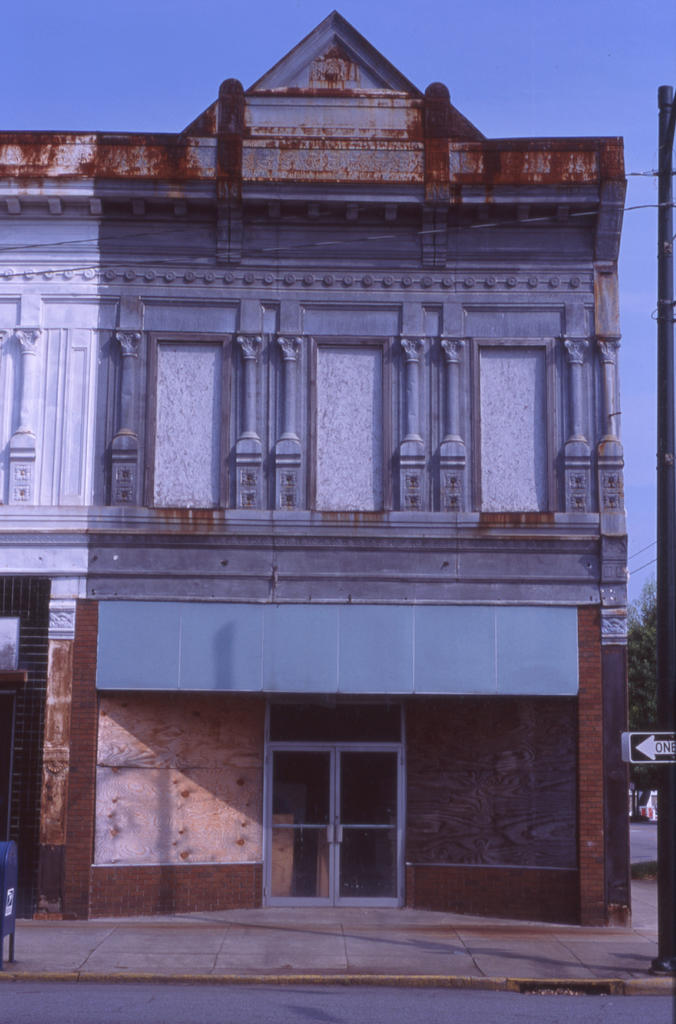
My buddy at work lives in Wilson. He commutes 45 minutes daily to Raleigh. His world has recently changed by the opening of a new bypass around Knightdale directly to the 440 loop. When we ask him why he does it, he talks about his 19th century house with 11' ceilings and the value of his dollar in a small town.
 I've shot a lot of small towns, and Wilson reminds me of a couple of them. It reminds me of Duluth, MN - a town that used to be busier. It reminds me of most every town between here and Columbia on Rt. 1 - towns where the conversation about "revitalizing the town center" is a couple generations too late.
 Within the dozen blocks I walked on a Sunday afternoon, an easy majority of storefronts were empty. If a town can be judged by the storefronts on its mainstreets, the primary industry of Wilson must be pentecostal evangelism, with barbering a quick second.
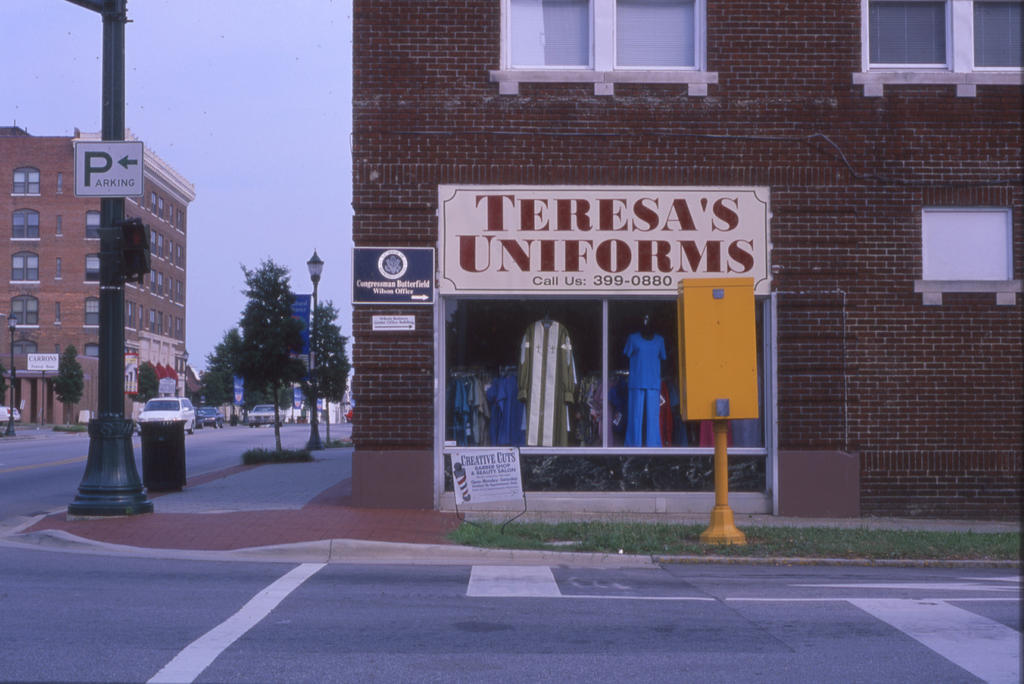 Photography inevitably betrays my emotion of the moment. Somehow in the collage of light and color and composition, a critic can deduce an accidental intent. Walking these streets on this Sunday afternoon, I was unprepared to be alone (my colleague was unable to meet me in town.) I was confused by the mash of ornament and styles (when exactly was Wilson's heyday?) I was confronted by another question of faith (why don't I believe that the depth of these ubiquitous storefront chapels goes beyond the catch-phrase in its window signage? Where are the believable churches and what could they do about the emptiness?)
(This was originially posted on Peace Arts OnLine)
Saturday, April 16, 2005
Southern Village and the Rest of the World
(Our servers are down today, so I'm getting some time to write.)
We met on site Tuesday in Southern Village, a planned community near Chapel Hill. Our site was a market square area - a horseshoe surrounding a small green with retail and office. The topography puts the square on a kind of sloping plateau, overlooking rolling residential streets with private homes on small lots. I noted to my supervisor that this square felt isolated - disconnected from any major city or thoroughfare. He responded that it was actually quite a large community.
This is a moment in history when developments, even whole towns are created, ex nihilo. Sprouting en masse, as if planted in entirely miscellaneous locations. In the past, development was traceable and predictable. It was at ports and points of trade, along rail corridors, or bounded by hills. Development now is selected, as if by darts on a map. Connection is not necessary (isolation is preferred.) Landscape is irrelevant. Natural resources are unleasable, redundant to public services, or undiscovered. A master plan is concocted in a half-week of meetings and late night brilliance while the grades are cleared. Construction is already behind schedule and delays are costing everyone money.
The master plan is too small.
North and South Bloodworth

Class lines in Raleigh are obscure. Where some towns have lines drawn by railroad tracks or school districts, Raleigh's seem to be drawn by developers and the limits of intention. These two storefronts are along South and North Bloodworth Street. The transition is over about four blocks of schoolyards, ball fields, and undeveloped land. Property values transition from mid 5 figures to mid 6. More telling are the portraits of homes - dilapidated two bedrooms to Victorian sixes. Driving through this Sunday, people were out on their streets, porches and yards - more in the South than the North. The shop owner on South Bloodworth approached us asking who we were and what the pictures were for. He was, to our surprise, white, mid-thirties, with a cell phone wired to his ear. He leaned against a telephone pole while we shot his store. The landcruiser was probably his. No one approached us on North Bloodworth, except for a man asking for money for food.
As a note - these shots were my first attempt at large format film (4x5). (!)

Wednesday, November 24, 2004
Vertigo on McDowell Street
 Since taking its picture last year, this diner has changed hands. “The Vertigo” didn’t even have time to take down the sign of the last tenant, but simply put their logo over top. This façade is extraordinarily simple, but it’s the accessories that create identity. Red benches where people could sit – they’re not the same, but they match, like a couple married for many years. The rows of newsstands like a lineup for dodgeball – pick your free paper, to the exclusion of all others. The colors are creative. The façade can be broken into very simple facets – color, proportion, signage, canopy, accessories. It’s a collage of parts, a happy collision of intent.
Subscribe to:
Posts (Atom)