Having finished the architecture exams, having finished Libeskind's book (3 1/2 stars), having no one scheduled to meet for lunch, I resumed a happy habit yesterday of reading at lunch. The weather's gloomy, and the park is far away, but I found a corner in the back of the office that was quiet. I picked up Dostoevsky's Brothers Karamazov, with its bookmark in the high 200's, and started diving in again.
And, with a book like this (not disimilar from Joyce's Ullysses in mass), "diving" is the right word. The "story" is so massive, so omnipresent, so existential and overtly narrative; the paragraphs are so enormous, that I find myself swimming in the words, foating in the middle of sentences, pondering the author's intent, wondering about the realities of life in america, comparing them to the proposed realities of life in russia, pondering faith and fiction. It's not as if my months away from the book leave me detached from the characters: in fact, I feel in many ways that I relate to them better, in a real-time sense, as if the characters have been living their lives as I have been living mine, and now we get back together for an hour at lunch.
To say I go back to work then, refreshed, may be an exageration. I did read about a duel yesterday, and that was exciting, until the dueler apologized and became a monk. I could do that - work feels more often like a duel.
Tuesday, January 24, 2006


Sunday, November 13, 2005
Upcoming Photo Show
I've been preparing prints for a small photo show in a local business office. Here's my write-up:
Raleigh in 6 Small Prints
Photography by Andy Osterlund
Downtown Raleigh continues to grow and change. If architecture can be read, Raleigh’s streetscapes are building a novel. Walking the sidewalks, a visitor finds chapters on warehouses and industry, moderately ornate turn-of-the-last-century storefronts, towers of a growing banking center, neighborhoods of eccentric affluence and communities of generations-old poverty. Dramatic chapters are being written now, and the suspense is building: a multi-modal transit hub, neighborhood redevelopment, a returning urban population.
These photos are portraits of our moment in architecture. Remember the colors, remember the shadows, the perpetual changing of places.
1. Fashion Center of New York, Inc. Wilmington Street
No.2 in a series of 4 storefronts. The second floor windows are blacked; daylight is visible at the first floor – the rear wall and roof are absent.
2. Reliable Loan Wilmington Street
Closed on Sundays, the best place in town to get a used diamond ring. Who can miss this color?
3. Smoked Turkey Grill South Street
A new business on a desperate block. Blocks around the corner from the Mayor’s house. Pegged a “gateway corridor;” pending wholesale community rehabilitation.
4. Dillon Supply Steel and Pipe Products Harrington Street
The solid brick warehouse edge of the downtown. Now being emptied to make way for a colossal transit hub. Three silver SUV's.
5. Audio Buys Glenwood Avenue, near Fairview
An experiment in the International Style, just like Mies. Set across a wasteland of an intersection, flanked by BP and trimmed with power lines.
6. Firestone at Dusk Dawson Street
The sun catches this tire shop and the city on the crest of a hill, on a one-way street out of town.
All 5x7 Cibachrome prints, non-digital; all available for purchase.
Thursday, November 10, 2005
Liking Libeskind More
I passed the half-way mark today in Libeskind's Breaking Ground - almost up to page 500 on my PDA. My opinions have shifted several times.
Before reading, my asumption was that this would be an eccentric explanation of life or archi-theory, detached in too many ways from actual living or construction. Instead, within the first few pages, Libeskind describes his family and his heritage, his warm partnership with his wife, and then the experiences of touching the foundations below what was the world trade center in NYC.
Second, because of the conversational style, I thought it would be too overtly ghost-written, and wouldn't likely describe anything architecturally significant. However, the next chapters describe profound experience and metaphor and architecture that goes beyond form-follows-function.
He describes a relationship between a building and the public that is rare and extraordinarily significant for a city. Stories are about the cultural need for certain projects, the public's aesthetic and functional desires, and then the very one-on-one bureaucracy that attempts to divert the people's attention.
The word "democracy" comes up often, related to architecture in the interest of the people.
Before reading, my asumption was that this would be an eccentric explanation of life or archi-theory, detached in too many ways from actual living or construction. Instead, within the first few pages, Libeskind describes his family and his heritage, his warm partnership with his wife, and then the experiences of touching the foundations below what was the world trade center in NYC.
Second, because of the conversational style, I thought it would be too overtly ghost-written, and wouldn't likely describe anything architecturally significant. However, the next chapters describe profound experience and metaphor and architecture that goes beyond form-follows-function.
He describes a relationship between a building and the public that is rare and extraordinarily significant for a city. Stories are about the cultural need for certain projects, the public's aesthetic and functional desires, and then the very one-on-one bureaucracy that attempts to divert the people's attention.
The word "democracy" comes up often, related to architecture in the interest of the people.
Tuesday, October 25, 2005
Breaking Ground with Daniel
Spurred by a non-architect's comments, I bought and started reading Daniel Libeskind's Breaking Ground: Adventures in Life and Architecture last night. An entirely theoretical architect until the last few years, this name has always been an intriguing mystery to me, and I'm excited to read his book - it looks actually pretty light for such an enigmatic character: I hope it's authentic. Of course, Libeskind has been in the news as the named champion of the New York WTC design competitions.
If anyone is interested in reading this with me, I guarantee you'll have no trouble keeping up. Let me know.
If anyone is interested in reading this with me, I guarantee you'll have no trouble keeping up. Let me know.
Sunday, October 16, 2005
Is Art Un-Presbyterian?
I've begun a study of Presbyterian thoughts about art. This started when I bumped into the Westminster Larger Catechism's explanation of the Second Commandment:
". . . the making any representation of God, of all or of any of the three persons, either inwardly in our mind, or outwardly in any kind of image or likeness of any creature whatsoever."
Our associate pastor has gotten me going on this too with some articles about the absense of Puritan art and general discussions of art in the church.
Reading Calvin's commentary today on the second commandment was very helpful. A few points: 1) All representational art is not wrong. 2) Representations of God are wrong because they insult God - so there's the bite to chew on. 3) Calvin and Westminster might not be saying the same thing.
Anyway - here's a link to Calvin on Commandment #2: http://www.ccel.org/c/calvin/comment3/comm_vol04/htm/iii.htm
Some comments from our associate pastor:
http://twosons.blogspot.com/2005/02/packer-pictures-of-christ.html#comments
If Calvin is right, what should we do with the Sistine Chapel? I can do without El Greco, and I still haven't seen Mel Gibson's Passion, and Monte Python's "Brian" was already blaspheme, and those laquered Jesus pictures always weirded me out, but Giotto and the Pietà Rondanini will be harder to let go.
This discussion will be continued on Peace Arts - www.peacepca.org/arts
". . . the making any representation of God, of all or of any of the three persons, either inwardly in our mind, or outwardly in any kind of image or likeness of any creature whatsoever."
Our associate pastor has gotten me going on this too with some articles about the absense of Puritan art and general discussions of art in the church.
Reading Calvin's commentary today on the second commandment was very helpful. A few points: 1) All representational art is not wrong. 2) Representations of God are wrong because they insult God - so there's the bite to chew on. 3) Calvin and Westminster might not be saying the same thing.
Anyway - here's a link to Calvin on Commandment #2: http://www.ccel.org/c/calvin/comment3/comm_vol04/htm/iii.htm
Some comments from our associate pastor:
http://twosons.blogspot.com/2005/02/packer-pictures-of-christ.html#comments
If Calvin is right, what should we do with the Sistine Chapel? I can do without El Greco, and I still haven't seen Mel Gibson's Passion, and Monte Python's "Brian" was already blaspheme, and those laquered Jesus pictures always weirded me out, but Giotto and the Pietà Rondanini will be harder to let go.
This discussion will be continued on Peace Arts - www.peacepca.org/arts
Wednesday, October 12, 2005
samples that sing
A quick qualifier in choosing materials -
I ordered some samples last week for a project: glass block and acrylic "glass" block. I tapped the glass one with my pen and it rang out this happy note - the tone changes depending where you hit it on the block. The acrylic block makes more of a "thud" tone. A famous quote says that, "architecture is frozen music." So . . . maybe I'll tell our client that we should use glass block instead of acrylic because in a hailstorm it would sing a nicer song. It might be easier to find another excuse.
I ordered some samples last week for a project: glass block and acrylic "glass" block. I tapped the glass one with my pen and it rang out this happy note - the tone changes depending where you hit it on the block. The acrylic block makes more of a "thud" tone. A famous quote says that, "architecture is frozen music." So . . . maybe I'll tell our client that we should use glass block instead of acrylic because in a hailstorm it would sing a nicer song. It might be easier to find another excuse.
Monday, September 12, 2005
A perpetuation of things
After visiting my parents recently, we came home with a set of goblets that had belonged to my grandparents. They're not extravagant, but they're heavy with an authentic art deco style that's a relief in our buy-stylish-merchandise-at-Target era. My grandparents used them for water glasses. Tonight, some time after dinner, I noticed the glasses still on the counter with a drop of pinot noir remaining in their bowls. I had a terrifying flash of guilt, considering (maybe naively), that this is the first time they've been used for alchohol in my conservative family, that somehow they had been desecrated.
The guilt passed quickly. But, it reminded me that these glass things had survived when the mood swings of families and mores had not. My wife and I discovered wine after college. At first it was a kind of elitist academic thing, being ushered in by eccentric connoisseurs who didn't mind buying so their company could experience the craft. Then, on a vacation to Spain, we ordered house wines with our dinner and enjoyed the taste and the happy experience and the absolute appropriateness of it. Now, you can throw in that connection with Jesus' first miracle and the communion table, and add to it many more enjoyable dinners with friends, and a glass of wine has become a wonderful gift, and a discovery.
So, it's nice to finally have some stemware, but I hope my grandparents aren't offended.
The guilt passed quickly. But, it reminded me that these glass things had survived when the mood swings of families and mores had not. My wife and I discovered wine after college. At first it was a kind of elitist academic thing, being ushered in by eccentric connoisseurs who didn't mind buying so their company could experience the craft. Then, on a vacation to Spain, we ordered house wines with our dinner and enjoyed the taste and the happy experience and the absolute appropriateness of it. Now, you can throw in that connection with Jesus' first miracle and the communion table, and add to it many more enjoyable dinners with friends, and a glass of wine has become a wonderful gift, and a discovery.
So, it's nice to finally have some stemware, but I hope my grandparents aren't offended.
Saturday, August 20, 2005
Welcome to Wilson
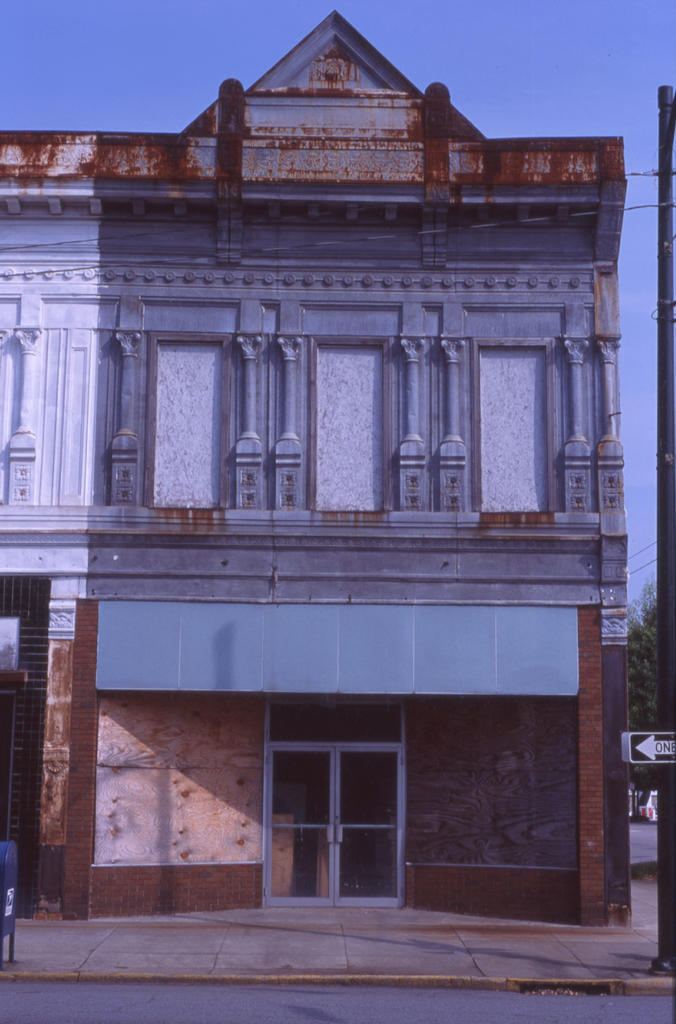
My buddy at work lives in Wilson. He commutes 45 minutes daily to Raleigh. His world has recently changed by the opening of a new bypass around Knightdale directly to the 440 loop. When we ask him why he does it, he talks about his 19th century house with 11' ceilings and the value of his dollar in a small town.
 I've shot a lot of small towns, and Wilson reminds me of a couple of them. It reminds me of Duluth, MN - a town that used to be busier. It reminds me of most every town between here and Columbia on Rt. 1 - towns where the conversation about "revitalizing the town center" is a couple generations too late.
 Within the dozen blocks I walked on a Sunday afternoon, an easy majority of storefronts were empty. If a town can be judged by the storefronts on its mainstreets, the primary industry of Wilson must be pentecostal evangelism, with barbering a quick second.
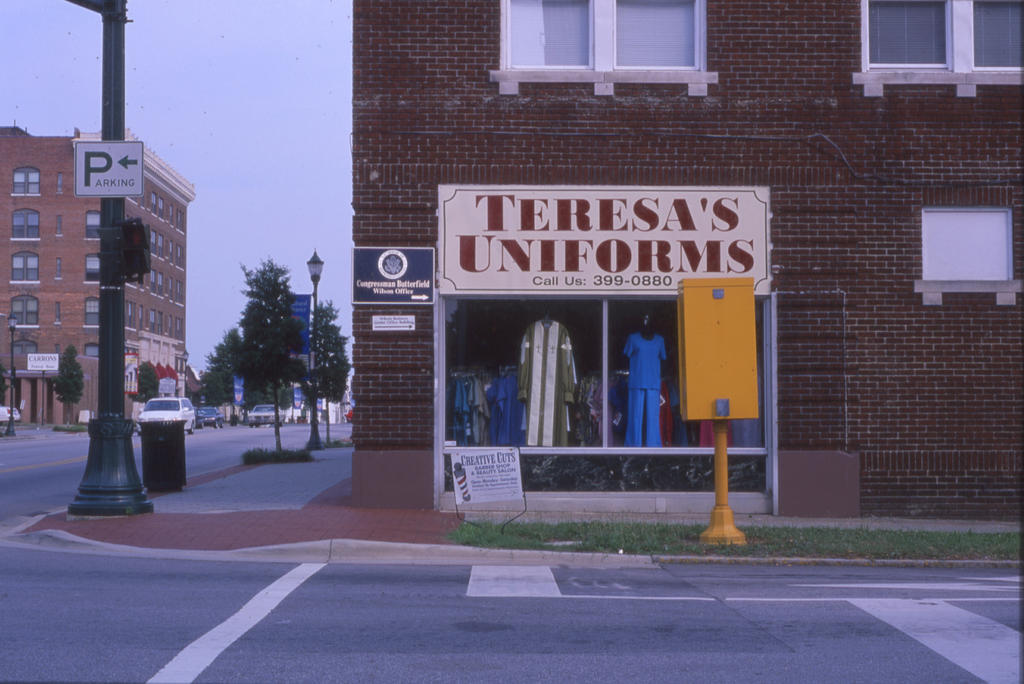 Photography inevitably betrays my emotion of the moment. Somehow in the collage of light and color and composition, a critic can deduce an accidental intent. Walking these streets on this Sunday afternoon, I was unprepared to be alone (my colleague was unable to meet me in town.) I was confused by the mash of ornament and styles (when exactly was Wilson's heyday?) I was confronted by another question of faith (why don't I believe that the depth of these ubiquitous storefront chapels goes beyond the catch-phrase in its window signage? Where are the believable churches and what could they do about the emptiness?)
(This was originially posted on Peace Arts OnLine)
Saturday, April 16, 2005
Southern Village and the Rest of the World
(Our servers are down today, so I'm getting some time to write.)
We met on site Tuesday in Southern Village, a planned community near Chapel Hill. Our site was a market square area - a horseshoe surrounding a small green with retail and office. The topography puts the square on a kind of sloping plateau, overlooking rolling residential streets with private homes on small lots. I noted to my supervisor that this square felt isolated - disconnected from any major city or thoroughfare. He responded that it was actually quite a large community.
This is a moment in history when developments, even whole towns are created, ex nihilo. Sprouting en masse, as if planted in entirely miscellaneous locations. In the past, development was traceable and predictable. It was at ports and points of trade, along rail corridors, or bounded by hills. Development now is selected, as if by darts on a map. Connection is not necessary (isolation is preferred.) Landscape is irrelevant. Natural resources are unleasable, redundant to public services, or undiscovered. A master plan is concocted in a half-week of meetings and late night brilliance while the grades are cleared. Construction is already behind schedule and delays are costing everyone money.
The master plan is too small.
We met on site Tuesday in Southern Village, a planned community near Chapel Hill. Our site was a market square area - a horseshoe surrounding a small green with retail and office. The topography puts the square on a kind of sloping plateau, overlooking rolling residential streets with private homes on small lots. I noted to my supervisor that this square felt isolated - disconnected from any major city or thoroughfare. He responded that it was actually quite a large community.
This is a moment in history when developments, even whole towns are created, ex nihilo. Sprouting en masse, as if planted in entirely miscellaneous locations. In the past, development was traceable and predictable. It was at ports and points of trade, along rail corridors, or bounded by hills. Development now is selected, as if by darts on a map. Connection is not necessary (isolation is preferred.) Landscape is irrelevant. Natural resources are unleasable, redundant to public services, or undiscovered. A master plan is concocted in a half-week of meetings and late night brilliance while the grades are cleared. Construction is already behind schedule and delays are costing everyone money.
The master plan is too small.
North and South Bloodworth

Class lines in Raleigh are obscure. Where some towns have lines drawn by railroad tracks or school districts, Raleigh's seem to be drawn by developers and the limits of intention. These two storefronts are along South and North Bloodworth Street. The transition is over about four blocks of schoolyards, ball fields, and undeveloped land. Property values transition from mid 5 figures to mid 6. More telling are the portraits of homes - dilapidated two bedrooms to Victorian sixes. Driving through this Sunday, people were out on their streets, porches and yards - more in the South than the North. The shop owner on South Bloodworth approached us asking who we were and what the pictures were for. He was, to our surprise, white, mid-thirties, with a cell phone wired to his ear. He leaned against a telephone pole while we shot his store. The landcruiser was probably his. No one approached us on North Bloodworth, except for a man asking for money for food.
As a note - these shots were my first attempt at large format film (4x5). (!)

Wednesday, November 24, 2004
Vertigo on McDowell Street
 Since taking its picture last year, this diner has changed hands. “The Vertigo” didn’t even have time to take down the sign of the last tenant, but simply put their logo over top. This façade is extraordinarily simple, but it’s the accessories that create identity. Red benches where people could sit – they’re not the same, but they match, like a couple married for many years. The rows of newsstands like a lineup for dodgeball – pick your free paper, to the exclusion of all others. The colors are creative. The façade can be broken into very simple facets – color, proportion, signage, canopy, accessories. It’s a collage of parts, a happy collision of intent.
Sunday, October 31, 2004
Farnsworth House
 The best thing for me about the Arts Conference lecture was the chance to put some of this into words - some of how I relate to Architecture, and some of why I think the built world matters to me as a citizen and as a believer in a Creative God.
This year, our church held its Second Annual Ping-Pong Tournament.Despite the obvious gratification of the contest at hand, it had the benefit of a perpetuity and tradition that the First Annual Ping-Pong Tournament only hoped toward. Tonight, as a matter of discipline, I'm beginning what I hope will be the first in a series of descriptions of images, images of Architecture.
This photo is from 1995, in Plano, Illinois, looking across the Fox River toward what I knew from school as Ludwig Mies Van Der Rohe's Farnsworth House. There's some recent news about this house, that it's been purchased for posterity by the National Trust. In school, it was touted as one of the pinnacles of Modernism. For me, it is a favorite second to Philip Johnson's Glass House in Connecticut.
This photo shows the closest I ever got to this house. We actually drove by once in the summer, but the leafy trees entirely obscured any view.
Most of Mies' other work is highly public - either skyscrapers in Chicago and New York or academic. The absolute clarity of the structure, that is the definition of Modern in these buildings, is obvious and unobscured. It sits exactly on the right-of-way of a city block, perceived by countless commuters in its full statement on order.
There was no way for me to get a clear shot of the Farnsworth House without climbing a barbed fence or swimming a frozen river. But, the order of this piece of modern elegance is still obvious as it sits in surprisingly harmonious contrast to the natural order of the overgrowth around it. In the gray of winter (and this was almost Spring!), the white of the steel even mimics the white on the water.
Trying to write more about this masterpiece gets a little more academic than I mean to go, so I'll stop there with simple associations. How cool to see steel speak the same language as old woods and water?
Saturday, September 25, 2004
Peace Architecture Class Outline
Intro:
Goals – notice your environment
Principles for any profession
I. A Theory of Christian Architecture (or “No Pictures Part 1”)
a. It’s okay to disagree – please use your comment card.
i. Acts 28:25
b. The earth is important; Everything God Created is Good – Be Thankful.
i. 1 Timothy 4:4
c. Notice your built environment.
i. Romans 1:20
d. Do not judge.
i. Luke 6:37
e. Nature longs for redemption,
i. Romans 8:18-21
f. Materials
i. 1 Corinthians 3:12-15
ii. Revelation 21:17-21
g. Craft
i. Exodus 31:1-11
II. XL, L, M, S (or “Pictures”)
a. XL – Maps
b. L – Streets
c. M – Shops
d. S – People and their houses
III. Response (or “No Pictures Part 2”)
a. Conversation
i. Philippians 4:8
ii. What do you remember enough to talk about?
1. Do you only remember the ugly?
b. Activism
i. Matthew 18:15-18
1. Sins against us: irresponsible clearing and leveling of land, excessive lighting (power waste, light pollution), dangerous traffic patterns (Crossroads), lack of innovation ("Sing to the LORD a new song, his praise from the ends of the earth" Isaiah 42:10), oppressive signage.
2. Who do we talk to?
a. Developers
b. Governments, but ordinances generally backfire.
c. Evangelism
i. Ezekiel 43:10 – 11
1. There is such a thing as a redemptive plan
ii. Romans 8:18-22
1. Through prayerful design, we begin to redeem nature - it's our job.
iii. Don't be ashamed of the Gospel, relate it to your environment and the people there. Preach on the street corners - preach about the street corners. Pray for the street corners. Pray for businesses. Pray for planners.
d. The Cure for Modernism = love
i. Exodus 20: Ten Commandments
1. No other gods – whatever you do, work for the Lord – Colosians 3:23
2. No idols – Frank Gehry isn’t perfect
3. Not misuse the name of the Lord – be a professional Christian
4. Remember the Sabbath – make a place for the sacred
5. Honor your father and mother – remember history
6. Shall not murder – be safe; don’t hate your neighborhood
7. Shall not commit adultery - overindulgence
8. Shall not steal – thoughtless repetition
9. Shall not give false testimony – honest materials
10. Shall not covet – simple signage
ii. Luke 6:31: Do to others as you would have them do to you.
1. Don’t support buildings you don’t like
iii. Romans 13:9-10: Love your neighbor, not rules
Goals – notice your environment
Principles for any profession
I. A Theory of Christian Architecture (or “No Pictures Part 1”)
a. It’s okay to disagree – please use your comment card.
i. Acts 28:25
b. The earth is important; Everything God Created is Good – Be Thankful.
i. 1 Timothy 4:4
c. Notice your built environment.
i. Romans 1:20
d. Do not judge.
i. Luke 6:37
e. Nature longs for redemption,
i. Romans 8:18-21
f. Materials
i. 1 Corinthians 3:12-15
ii. Revelation 21:17-21
g. Craft
i. Exodus 31:1-11
II. XL, L, M, S (or “Pictures”)
a. XL – Maps
b. L – Streets
c. M – Shops
d. S – People and their houses
III. Response (or “No Pictures Part 2”)
a. Conversation
i. Philippians 4:8
ii. What do you remember enough to talk about?
1. Do you only remember the ugly?
b. Activism
i. Matthew 18:15-18
1. Sins against us: irresponsible clearing and leveling of land, excessive lighting (power waste, light pollution), dangerous traffic patterns (Crossroads), lack of innovation ("Sing to the LORD a new song, his praise from the ends of the earth" Isaiah 42:10), oppressive signage.
2. Who do we talk to?
a. Developers
b. Governments, but ordinances generally backfire.
c. Evangelism
i. Ezekiel 43:10 – 11
1. There is such a thing as a redemptive plan
ii. Romans 8:18-22
1. Through prayerful design, we begin to redeem nature - it's our job.
iii. Don't be ashamed of the Gospel, relate it to your environment and the people there. Preach on the street corners - preach about the street corners. Pray for the street corners. Pray for businesses. Pray for planners.
d. The Cure for Modernism = love
i. Exodus 20: Ten Commandments
1. No other gods – whatever you do, work for the Lord – Colosians 3:23
2. No idols – Frank Gehry isn’t perfect
3. Not misuse the name of the Lord – be a professional Christian
4. Remember the Sabbath – make a place for the sacred
5. Honor your father and mother – remember history
6. Shall not murder – be safe; don’t hate your neighborhood
7. Shall not commit adultery - overindulgence
8. Shall not steal – thoughtless repetition
9. Shall not give false testimony – honest materials
10. Shall not covet – simple signage
ii. Luke 6:31: Do to others as you would have them do to you.
1. Don’t support buildings you don’t like
iii. Romans 13:9-10: Love your neighbor, not rules
Sunday, August 29, 2004
Vaudevillian Horizontalism
Scanned through one of these xeroxed articles passed on to me en masse, "Christian Worship in Consecrated Space and Time." It took me too long to realize that the relevant section of the article was a two-paragraph bit near the end. "Finally, we come to the architectural articulation of the place of solemn assembly."
"Since the Jesus Christ is the temple of God, there remains no particular geographic place or space that is essentially sacred or rendered sacred by particular rites or specially designated officers, for the people of God is consecrated in Christ. Consequently, it is possible to gather anywhere and use any kind of building for worship. . . it is not true that the design of worship space has been rendered secondary or unneccessary by Christ's coming. Rather such design should symbolically evoke the ordered world revealed through the lens of redemption and experienced in the life of the church."
Arie C. Leder - Calvin Theological Journal
I'm not in a hurry to discuss the necessities in church Architecture. This article describes the modern church building as "vaudevillian horizontalism," meaning, my dictionaries tell me, theaters for entertaining our neighbors with little expression of our vertical relationship between God and man of praise, worship, prayer, holiness, symbolism, revelation, and the sacred. I don't deny this threat, and as a deacon board member with a budget, I won't pretend to know the answer.
In the urban context, this is a reminder to look for the sacred streetcorners. To start, is the church in the town center? No? Is there a town center? No? Is there anywhere that cars have to slow down and recognize a moment in space and time? Only at stop lights and accidents and drive-thru's. Vaudevillian horizontalism seems about right.
"Since the Jesus Christ is the temple of God, there remains no particular geographic place or space that is essentially sacred or rendered sacred by particular rites or specially designated officers, for the people of God is consecrated in Christ. Consequently, it is possible to gather anywhere and use any kind of building for worship. . . it is not true that the design of worship space has been rendered secondary or unneccessary by Christ's coming. Rather such design should symbolically evoke the ordered world revealed through the lens of redemption and experienced in the life of the church."
Arie C. Leder - Calvin Theological Journal
I'm not in a hurry to discuss the necessities in church Architecture. This article describes the modern church building as "vaudevillian horizontalism," meaning, my dictionaries tell me, theaters for entertaining our neighbors with little expression of our vertical relationship between God and man of praise, worship, prayer, holiness, symbolism, revelation, and the sacred. I don't deny this threat, and as a deacon board member with a budget, I won't pretend to know the answer.
In the urban context, this is a reminder to look for the sacred streetcorners. To start, is the church in the town center? No? Is there a town center? No? Is there anywhere that cars have to slow down and recognize a moment in space and time? Only at stop lights and accidents and drive-thru's. Vaudevillian horizontalism seems about right.
Saturday, August 28, 2004
Learning from Fuquay Varina
Started going through slides last night to prepare for the conference. I started with Fuquay-Varina, since those slides are the most recent.
The points to make from these tiny towns are probably enough for an hour course themselves, maybe a semester.
These points are from Fuquay's mainstreet alone:
 1. What is the role of the individual shop owner? Is there any moral imperative for supporting him? Isn't it better to have the selection, low prices, bulk shipping, accountability that wholesale department stores offer? Is there a compromise option? Is there a Biblical model for the individual retailer, or just an American one?
 2. Building elements survey: door, sales window, signage, facade, canopy, parapet (Genesis 1:6 And God said, "Let there be an expanse between the waters to separate water from water.") What is a canopy really for? What does it do to a storefront?
 3. Gas stations: no hiding the gas station in a small town. They become a feature. They are polished and orderly. They fill their site well. They look like elegant modern furniture.
 4. "Expect a Miracle Christian Bookstore" What is the nature of explicitly Christian retail? Is it pretending to be something else - this store looks like a country porch? Is that marketing, or a reaction of the hearts at peace inside? Contrast with "Family Bookstore" at the urban mall.
 5. Catastrophic signage. How do we respond to the retailer of random goods? There are some moral issues here and isolation, but the change likely has to come from the inside. Who will have the patience to befriend this man?
 6. Perfect signage, perfect proportions, detailed brickwork. What, no canopy? How is a storeowner compelled to be so rational in his design? What went right here?
 7. Aha! It's his house! That's what went right - personal responsibility and care.
 8. The urban courtyard. It may be space for infill, but it adds depth and complexity to a streetfront. Outdoor malls have similar configurations, but the open space is reserved for parking, not for people. Note the picnic table.
 9. Rear signage - take responsibility for your backyard - makes the potential for other uses of the service aisles.
 10. National retail chains on their day off = empty parking lots and ugly architecture. This Hudson Belk is offensive in its minimalism. If I were to write a letter to the store owner, what could I say? Empty space cannot be ignored. My guess is that its the sin of sloth, maybe adultery.
 11. Grace Presbyterian Church. The most beautiful featureless storefront I've ever seen. Maybe the cure for modernism is love.
 12. Studies on signage and color and mixed use.
Everything I need to know about Architecture I learned from Fuquay.
The points to make from these tiny towns are probably enough for an hour course themselves, maybe a semester.
These points are from Fuquay's mainstreet alone:
1. What is the role of the individual shop owner? Is there any moral imperative for supporting him? Isn't it better to have the selection, low prices, bulk shipping, accountability that wholesale department stores offer? Is there a compromise option? Is there a Biblical model for the individual retailer, or just an American one?
2. Building elements survey: door, sales window, signage, facade, canopy, parapet (Genesis 1:6 And God said, "Let there be an expanse between the waters to separate water from water.") What is a canopy really for? What does it do to a storefront?
3. Gas stations: no hiding the gas station in a small town. They become a feature. They are polished and orderly. They fill their site well. They look like elegant modern furniture.
4. "Expect a Miracle Christian Bookstore" What is the nature of explicitly Christian retail? Is it pretending to be something else - this store looks like a country porch? Is that marketing, or a reaction of the hearts at peace inside? Contrast with "Family Bookstore" at the urban mall.
5. Catastrophic signage. How do we respond to the retailer of random goods? There are some moral issues here and isolation, but the change likely has to come from the inside. Who will have the patience to befriend this man?
6. Perfect signage, perfect proportions, detailed brickwork. What, no canopy? How is a storeowner compelled to be so rational in his design? What went right here?
7. Aha! It's his house! That's what went right - personal responsibility and care.
8. The urban courtyard. It may be space for infill, but it adds depth and complexity to a streetfront. Outdoor malls have similar configurations, but the open space is reserved for parking, not for people. Note the picnic table.
9. Rear signage - take responsibility for your backyard - makes the potential for other uses of the service aisles.
10. National retail chains on their day off = empty parking lots and ugly architecture. This Hudson Belk is offensive in its minimalism. If I were to write a letter to the store owner, what could I say? Empty space cannot be ignored. My guess is that its the sin of sloth, maybe adultery.
11. Grace Presbyterian Church. The most beautiful featureless storefront I've ever seen. Maybe the cure for modernism is love.
12. Studies on signage and color and mixed use.
Everything I need to know about Architecture I learned from Fuquay.
Wednesday, August 25, 2004
The Cure for Modernism
A few points here, but mainly a reference to the irrelevance of the title. Modernism in architecture generally refers to the minimalism of decoration, clarity of forms, economy in structure and function. The conversation on modular construction began here with high hopes for low-income housing and expedient build times.
The disease of modernism came when the only words the developers heard were "cheap," "fast," and "build-to-suit."
The most elegant expressions of modernism came with Mies Van Der Rohe with his steel and glass apartment buildings, institutional halls, and houses (Chicago +/-). While these were modular with their proportions and general in their function, they were not fast and certainly not cheap.
The most devastating expressions of modernism came in the mass-housing facilities of every major urbanity, based on part of Le Corbusier's Unites d'Habitation, the part where a lot of people can fit on a small footprint of land.
While post-modernism certainly has its own crises, it offers some opportunity for the developer / planner / owner to take responsibility for his actions while coming closer than ever to his goals of cheap, fast, and modular. This is done largely through cheaper, more functional, more available, more environmentally beneficial, more easily worked materials.
So, part of the "pill" is new materials and methods. But it means that the designers have to go back to work. Innovation has to be in our vocabulary again. Where the citizen was voiceless against the modernist economy, today he can make demands on those who build his environment. He can demand beauty and functionality without expecting the inconvenience of lead-times and price increases.
The disease of modernism came when the only words the developers heard were "cheap," "fast," and "build-to-suit."
The most elegant expressions of modernism came with Mies Van Der Rohe with his steel and glass apartment buildings, institutional halls, and houses (Chicago +/-). While these were modular with their proportions and general in their function, they were not fast and certainly not cheap.
The most devastating expressions of modernism came in the mass-housing facilities of every major urbanity, based on part of Le Corbusier's Unites d'Habitation, the part where a lot of people can fit on a small footprint of land.
While post-modernism certainly has its own crises, it offers some opportunity for the developer / planner / owner to take responsibility for his actions while coming closer than ever to his goals of cheap, fast, and modular. This is done largely through cheaper, more functional, more available, more environmentally beneficial, more easily worked materials.
So, part of the "pill" is new materials and methods. But it means that the designers have to go back to work. Innovation has to be in our vocabulary again. Where the citizen was voiceless against the modernist economy, today he can make demands on those who build his environment. He can demand beauty and functionality without expecting the inconvenience of lead-times and price increases.
Tuesday, August 24, 2004
Manipulated by Camus
I finished "The Fall" today. According to my marks in the margins, I've actually read this before, at least to within the last 10 pages, but I didn't remember a word of it. In grammar school, we learned that you can't write a story in 2nd person. The reason for this now I understand isn't that it's impossible, but that it's cruel. I became the character to whom the author was speaking. Even when I wasn't reading the book, during the day, I was that 2nd person. And to learn that I had driven the protagonist to his provacative end, what kind of man am I? "It's always too late. Fortunately." Oh dreadful, so revealing.
Evangelism
Ezekiel 43:10 "Son of man, describe the temple to the people of Israel, that they may be ashamed of their sins. Let them consider the plan, 11 and if they are ashamed of all they have done, make known to them the design of the temple-its arrangement, its exits and entrances-its whole design and all its regulations and laws. Write these down before them so that they may be faithful to its design and follow all its regulations.
- There is such a thing as a redemptive plan.
Romans 8:18 The creation waits in eager expectation for the sons of God to be revealed. 20For the creation was subjected to frustration, not by its own choice, but by the will of the one who subjected it, in hope 21that the creation itself will be liberated from its bondage to decay and brought into the glorious freedom of the children of God.
22We know that the whole creation has been groaning as in the pains of childbirth right up to the present time.
- Through prayerful design, we begin to redeem nature - it's our job. I don't want to exagerrate this reference, but the connection is clear, that sin does not only affect our souls, but it has affected nature and the built environment.
- What is "Christian" design? What would Jesus do? Follow the 10 commandments and the golden rule: make no idols (no showy buildings), do not covet (simple signage), do not bear false witness (honest materials), love your neighbor (relate to your context), do unto others as you would have done to you (don't build buildings you don't like).
- But, how do we make the connection to Jesus? How do we preach the gospel through design? The surface answer is probably the best - communicate with developers and planners and builders and shopowners and tell them what the Bible says about what they're doing. Don't be ashamed of the Gospel, relate it to your environment and the people there. Preach on the street corners - preach about the street corners. Pray for the street corners. Pray for businesses. Pray for planners.
- There is such a thing as a redemptive plan.
Romans 8:18 The creation waits in eager expectation for the sons of God to be revealed. 20For the creation was subjected to frustration, not by its own choice, but by the will of the one who subjected it, in hope 21that the creation itself will be liberated from its bondage to decay and brought into the glorious freedom of the children of God.
22We know that the whole creation has been groaning as in the pains of childbirth right up to the present time.
- Through prayerful design, we begin to redeem nature - it's our job. I don't want to exagerrate this reference, but the connection is clear, that sin does not only affect our souls, but it has affected nature and the built environment.
- What is "Christian" design? What would Jesus do? Follow the 10 commandments and the golden rule: make no idols (no showy buildings), do not covet (simple signage), do not bear false witness (honest materials), love your neighbor (relate to your context), do unto others as you would have done to you (don't build buildings you don't like).
- But, how do we make the connection to Jesus? How do we preach the gospel through design? The surface answer is probably the best - communicate with developers and planners and builders and shopowners and tell them what the Bible says about what they're doing. Don't be ashamed of the Gospel, relate it to your environment and the people there. Preach on the street corners - preach about the street corners. Pray for the street corners. Pray for businesses. Pray for planners.
Monday, August 23, 2004
Activism
Matthew 18:15-18 "If your brother sins against you, go and show him his fault, just between the two of you. If he listens to you, you have won your brother over. But if he will not listen, take one or two others along, so that 'every matter may be established by the testimony of two or three witnesses.' If he refuses to listen to them, tell it to the church; and if he refuses to listen even to the church, treat him as you would a pagan or a tax collector.
How do we decide what the sins against us are?
A few ideas: irresponsible clearing and leveling of land, excessive lighting (power waste, light pollution), dangerous traffic patterns (Crossroads), lack of innovation ("Sing to the LORD a new song, his praise from the ends of the earth" Isaiah 42:10), oppresive signage (Can we use the 4th ammendment? Maybe it's a stretch, maybe not.)
Who do we talk to?
Developers
Town ordinances often backfire and create loopholes. Make it a point of personal responsibility instead.
Go alone, then go with friends, go with your church, boycott.
How do we decide what the sins against us are?
A few ideas: irresponsible clearing and leveling of land, excessive lighting (power waste, light pollution), dangerous traffic patterns (Crossroads), lack of innovation ("Sing to the LORD a new song, his praise from the ends of the earth" Isaiah 42:10), oppresive signage (Can we use the 4th ammendment? Maybe it's a stretch, maybe not.)
Who do we talk to?
Developers
Town ordinances often backfire and create loopholes. Make it a point of personal responsibility instead.
Go alone, then go with friends, go with your church, boycott.
Conversation
A first part of reading a downtown is talking about it. When you get home to your family, what do you remember? What can you mention? The first things I hear when people talk to me about architecture - within seconds - is that strip malls are ugly and that Walmart has taken over. Yes, there are 4 Walmarts within 10 miles of my house, but if Walmart is the only building we remember in that 20 mile diameter, they're doing something that no other building has been able to do. Do we only remember the ugly? Why has our perspective become so dim? Or, is there something more insidious about Walmart than its landscape that causes us to remember it. In that case, we haven't remembered anything at all about the built environment within 10 miles from our home.
Can you name the nearest strip mall? Where is it? What is ugly about it? Is it a service to you? My guess is that our memories point to the 1965 modern shell with empty storefronts. Thankfully, this model appears to have failed and is being replaced. What is different about the replacements? More careful materials? Colors? Was the solution to the ugly problem of the strip mall that simple?
As an exercise for the class, we could try to have people list ten buildings they remember between their house and the church. Which of these would you like to talk about?
Can you name the nearest strip mall? Where is it? What is ugly about it? Is it a service to you? My guess is that our memories point to the 1965 modern shell with empty storefronts. Thankfully, this model appears to have failed and is being replaced. What is different about the replacements? More careful materials? Colors? Was the solution to the ugly problem of the strip mall that simple?
As an exercise for the class, we could try to have people list ten buildings they remember between their house and the church. Which of these would you like to talk about?
Subscribe to:
Posts (Atom)